Islamic Extremists’ Push for Sharia Law: Impacts in Europe and Implications for the United States
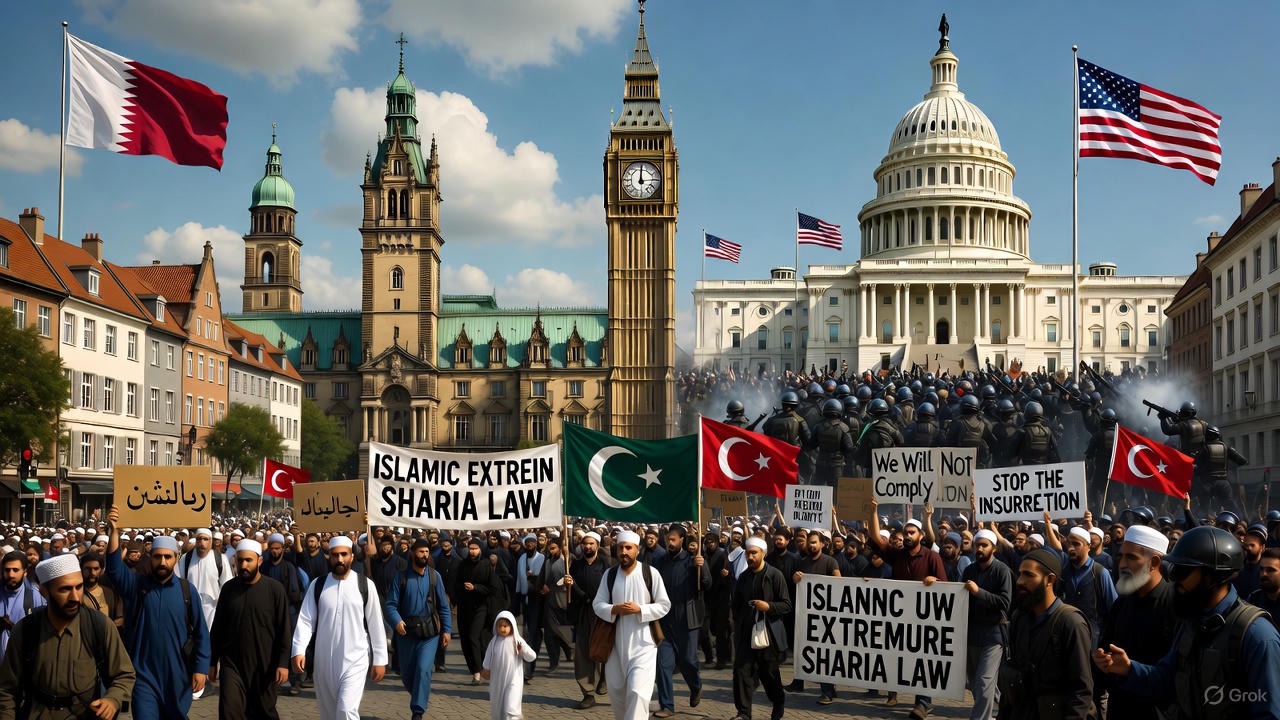
Islamic extremism refers to radical ideologies within Islam that promote violence, intolerance, and the imposition of strict religious governance to achieve political ends. A core demand among many such groups is the establishment of Sharia law—a legal system derived from the Quran and Hadith that governs personal, social, and political life in accordance with Islamic principles. While Sharia varies in interpretation and application, extremist versions often include harsh punishments, gender inequality, and suppression of non-Muslims, which conflict with secular democratic values.
In Europe, waves of migration, particularly from conflict zones in the Middle East and North Africa, have coincided with rising extremist activities. As of 2025, groups linked to political Islam, such as offshoots of the Muslim Brotherhood or Salafist networks, have been accused of promoting Sharia through protests, community organizing, and radicalization efforts. This has led to security threats, social tensions, and policy debates. For the United States, where freedom of religion is constitutionally protected, the rise of such demands could challenge core liberties if not addressed proactively. This paper reviews Europe’s experiences and extrapolates lessons for America.
Current Impacts in Europe
Europe has seen a marked increase in extremist activities advocating for Sharia law, fueled by radicalization, migration, and geopolitical influences. Recent analyses indicate that political Islam poses significant challenges, including radicalization linked to terrorism and violent extremism. For instance, in Germany, a 2024 rally in Hamburg organized by the group Muslim Interaktiv saw over a thousand extremists demanding a caliphate and Sharia implementation, prompting calls for minimum prison sentences for such agitators. This event highlighted the growing boldness of Islamist groups, with similar protests reported in the UK, France, Germany, and the Netherlands.
Security threats remain a primary concern. The Islamic State (IS) and al-Qaeda affiliates continue to evolve, with a 2025 report noting an increasing risk from individuals without prior records, complicating counterterrorism efforts. In Germany, the Islamist terror threat has shifted since 2020, with incidents underscoring the role of religious extremism in recruitment and attacks. Across Europe, radical offshoots have been tied to over 80 violent attacks on mosques and other sites in recent years, though these are often intra-Muslim or backlash-related.
Social and political impacts are profound. In countries like France and Belgium, Islamist networks infiltrate schools and communities, promoting segregation and indoctrination. A 2025 study on the rise of Islamism in the EU notes heightened tensions, with extremism exacerbating socio-political divisions despite most Muslims rejecting radical views. Anti-blasphemy extremism has surged, leading to legal debates over free speech and human rights. Public figures, such as British Islamic scholar Anjem Choudary, have predicted Sharia replacing democracy in the UK, Belgium, and France within decades.
Geopolitical factors amplify these issues. Networks supported by Qatar and Turkey have been accused of funding and influencing Salafist extremists in Europe, with hundreds of thousands of Syrian Islamists refusing repatriation to impose Sharia locally. This has led to parallel societies, increased lawlessness in migrant-heavy areas, and a surge in populist responses. In 2025, European governments, including the newly formed one in France, have expanded watchdogs on Islamist extremism, while proposals for banning Sharia across the continent gain traction, backed by over 50 lawmakers from 20 countries.
Overall, these developments have strained social cohesion, boosted far-right politics, and diverted resources toward counter-extremism, with some countries like Norway deporting radicals to reduce crime. The U.S. has collaborated with Europe on countering violent extremism, but growing Islamism negatively affects transatlantic interests.
Implications for the United States
If demands for Sharia law by Islamic extremists intensify in the U.S., the consequences could mirror Europe’s challenges but be amplified by America’s diverse population and strong constitutional protections. Extremist interpretations of Sharia are fundamentally incompatible with the U.S. Constitution, as they seek supremacy over secular law, violating Article VI’s Supremacy Clause. Under such systems, non-Muslims are treated as enemies, minorities persecuted, and women subjected to severe restrictions—directly clashing with freedoms of speech, religion, and equality.
Potential risks include subversion through “stealth jihad,” where groups use democratic processes to build influence, establish parallel communities, and push for Sharia accommodations. Organizations like the Muslim Brotherhood have been linked to efforts to impose Sharia via ballots or force, funding extremism on U.S. campuses and beyond. This could lead to increased radicalization, as seen in associations between religious motivation and terrorism.
Socially, it might foster division, with demands for Sharia courts or exemptions eroding the rule of law. Politically, it could violate laws against conspiracy to defraud the U.S. (18 U.S. Code § 371) by obstructing constitutional functions through deceit. Security threats from jihadist networks, potentially leading to attacks or “no-go” zones, would strain resources and heighten tensions.
To mitigate, the U.S. could strengthen immigration vetting, monitor foreign funding, and uphold Judeo-Christian heritage while protecting constitutional rights. Unlike Europe, America’s robust Second Amendment and federal structure might deter overt takeovers, but proactive measures are essential to prevent cultural erosion.
Conclusion
The push for Sharia by Islamic extremists in Europe has created security vulnerabilities, social fractures, and policy dilemmas, serving as a cautionary tale for the U.S. If unchecked, similar trends could undermine American freedoms and constitutional integrity. Policymakers must balance religious liberty with vigilance against subversion, promoting integration and countering radical ideologies through education and law enforcement. Ultimately, defending democratic values requires distinguishing peaceful practice from extremist agendas.
References
This paper incorporates insights from various sources, including think tank reports, news articles, and public social media discussions, to provide a comprehensive view as of December 19, 2025.